News Corp’s Australian chair claims ‘activist’ athletes hurt grassroots sport | Australia sport

News Corp’s Australian chair claims ‘activist’ athletes hurt grassroots sport | Australia sport

Rupert Murdoch’s Australian chief executive has accused athletes of hurting sport when they become “activists” and reject sponsorships from mining or energy companies.

The executive chair Australasia of News Corp Australia, Michael Miller, told a sporting leadership conference that athletes who reject sponsors don’t lose any pay but the “grassroots” sporting organisations suffer as a result of their activism.

News Corp is the largest publisher in Australian with mastheads including the Australian, the Daily Telegraph, the Herald Sun and news.com.au, and the pay TV channel Sky News Australia.

Miller appeared to reference the withdrawal of Hancock Prospecting’s $15m sponsorship from Netball Australia last year after a player backlash.

The backlash was sparked by First Nations squad member Donnell Wallam who expressed an objection to wearing a uniform with the Hancock logo on it because the founder of Hancock Prospecting and father of Gina Rinehart, Lang Hancock, suggested Indigenous Australians should be sterilised.

Speaking on a panel at the SportNXT Shaping the Future of Sport conference in Melbourne, Miller said: “Stars are your biggest strength and your biggest liability.

Michael Miller: sports stars can have ‘negative impact’ when they become ‘activists’ – video

“When sporting stars become activists, it has a negative impact on the growth of the game, in terms of athletes choosing who their sponsors are and who they will and won’t work with.

A panel of globally recognised leaders chime in on the state of sport both in Australia and globally.

Moderated by @TraceyLeeHolmes, the panel incl. ICC Chair Greg Barclay, NBA Asia MD Ramez Sheikh, News Corp Exec Chairman Michael Miller & Melbourne FC President Kate Roffey. pic.twitter.com/lT7cxwZflM

— SportNXT (@sportnxtau) March 28, 2023

“You employ people, you come to work accepting that the team, the company you work for, make decisions your behalf, and for athletes to take a fairly firm decision they don’t want to take a sponsorship from a mining company, from an energy company … their pay isn’t going to suffer, but ultimately it’s the grassroots and pathway programs that will.”

Questioned by the moderator, ABC journalist Tracey Holmes, Miller doubled down on his remarks.

“I find that athletes feel they have permission to make those statements, but other organisations wouldn’t accept it,” he said. “If you don’t want to work for that organisation, you leave and work elsewhere.”

skip past newsletter promotion

Another panellist, the president of the Melbourne Football Club, Kate Roffey, disagreed with Miller.

Roffey said she supported her players, which she called her greatest assets, and if they had issues with sponsors, they were well within their rights to speak up.

“It’s only courtesy, it’s not my responsibility to ask them what’s important to them as athletes,” Roffey said.

Miller was critical of sporting codes that made it difficult for the media to cover them by scheduling multiple matches at the same time and said it was important to give the media access to stories and personalities.

He also said Foxtel’s sports streaming service, Kayo, had figures that showed more men were watching women’s sport than women and it was a challenge getting women to watch women’s sports.

How the Medicare political wars could hurt seniors : Shots

How the Medicare political wars could hurt seniors : Shots

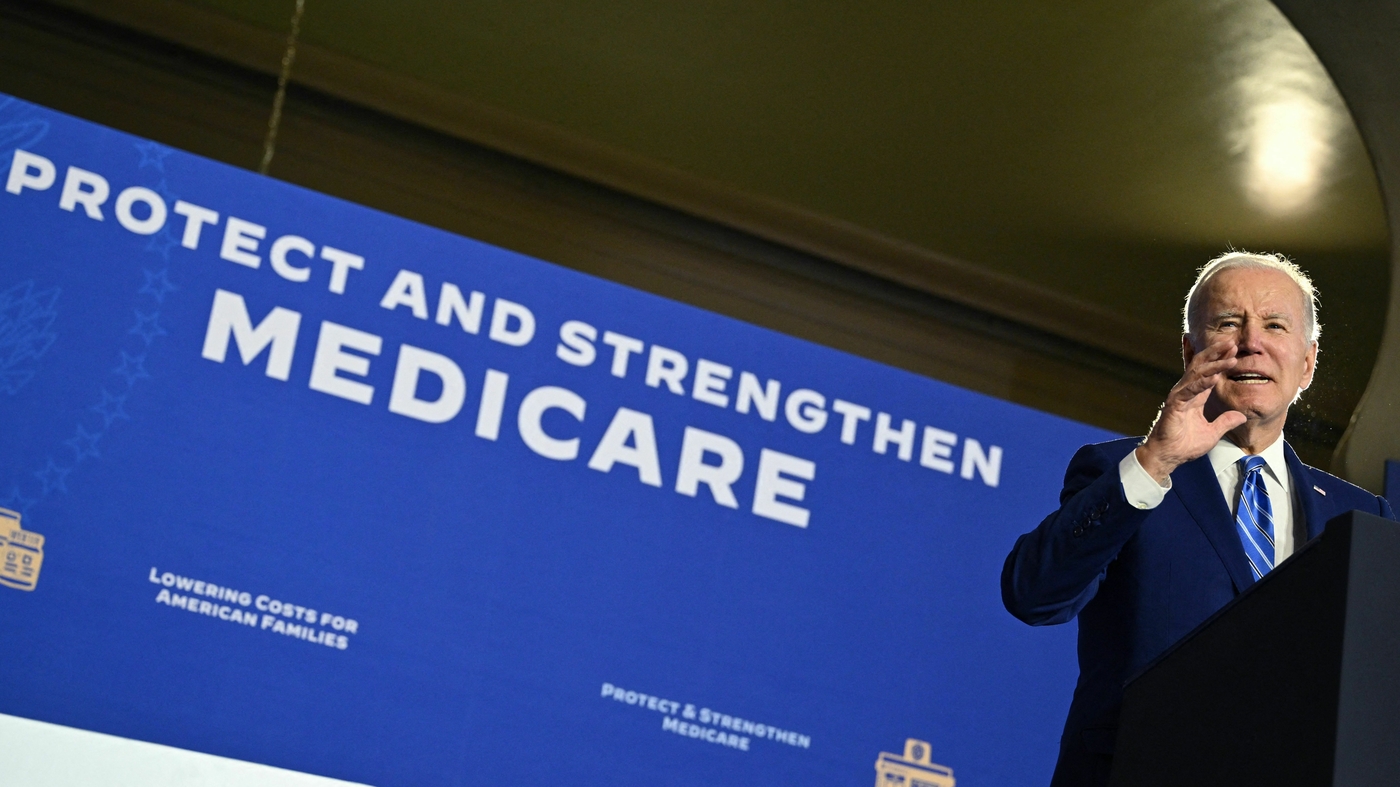
Last week in Florida, at the University of Tampa, President Joe Biden promised to protect and strengthen Social Security and Medicare, as well as lower health care costs.

Mandel Ngan/AFP via Getty Images


hide caption

toggle caption

Mandel Ngan/AFP via Getty Images


Last week in Florida, at the University of Tampa, President Joe Biden promised to protect and strengthen Social Security and Medicare, as well as lower health care costs.

Mandel Ngan/AFP via Getty Images

The Medicare wars are back, and almost no one in Washington is surprised.

This time it’s Democrats accusing Republicans of wanting to maim the very popular federal health program that covers 64 million seniors and people with disabilities. In the past, Republicans have successfully pinned Democrats as the threat to Medicare.

Why do politicians persistently wield Medicare, as well as Social Security, as weapons? Because history shows that works at the ballot box. Generally, the party accused of menacing the sacrosanct entitlements pays a price — although it’s the millions of beneficiaries relying on feuding lawmakers to keep the programs funded who stand to lose the most.

Republicans have repeatedly warned they would hold raising the federal debt ceiling hostage unless Democrats negotiated changes to Medicare, Medicaid, and Social Security. The three programs together, along with funding for the Affordable Care Act and Children’s Health Insurance Program, account for nearly half of the federal budget.

The political bomb that went off during President Joe Biden’s State of the Union speech had been ticking for weeks. In his speech, Biden threatened to veto any Republican efforts to cut Social Security or Medicare. It was one of only three veto threats he made that night. During a trip to Florida after the speech, he said it more forcefully: “I know a lot of Republicans, their dream is to cut Social Security and Medicare. Well, let me say this: If that’s your dream, I’m your nightmare.”

Senior Republicans have distanced themselves from the proposals Biden was referencing, notably ideas from the House Republican Study Committee and Sen. Rick Scott, R-Fla., to make cuts or even let Medicare expire unless Congress votes to keep it going.

“That’s not the Republican plan; that’s the Rick Scott plan,” Senate Minority Leader Mitch McConnell said on a Kentucky radio show Feb. 9, echoing his opposition to the plan last year.

“Cuts to Social Security and Medicare are off the table,” House Speaker Kevin McCarthy declared the day before Biden’s veto threat.

McConnell and McCarthy know something that Rick Scott apparently does not: Politicians threaten big, popular entitlement programs at their peril. And, usually, it’s been Republicans who suffer the electoral consequences.

How Medicare fights have shaped elections

This dates at least to 1982, when Democrats used threats of Republican cuts to Social Security to pick up more than two dozen House seats in President Ronald Reagan’s first midterm elections. In 1996, President Bill Clinton won reelection in part by convincing voters that Republicans led by House Speaker Newt Gingrich wanted to privatize Medicare and Social Security.

At the beginning of his second term, in 2005, President George W. Bush made it his top priority to “partially privatize” Social Security. That proved singularly unpopular. In the following midterm elections, Democrats won back the House for the first time since losing it in 1994.

In 2010, Republicans turned the tables, using what they described as “Medicare cuts” in the Affordable Care Act to sweep back to power in the House. (Those “cuts” were mostly reductions in payments to providers; beneficiaries actually got extra benefits through the ACA.)

The use of the Medicare cudgel likely reached its zenith in 2012, when Democrats took aim at Medicare privatization proposals offered by Paul Ryan, the House Budget Committee chair and Republican vice presidential candidate. That debate produced a controversial political ad, paid for by the progressive Agenda Project Action Fund and recalled by many in Washington, that showed a suited man in a red tie – presumably, Ryan – dumping a wheelchair-bound “granny” off a cliff as the words flashed, “Is America Beautiful without Medicare?”

The reality is that Medicare’s value as a political weapon also sabotages any effort to come together in a bipartisan way to solve the program’s financing problems. The last two times the Medicare Hospital Insurance Trust Fund was this close to insolvency — in the early 1980s and late 1990s — Congress passed bipartisan bills to keep the program afloat.

One person’s ‘cut’ can be another’s ‘benefit’

Even the word “cut” can be political. One stakeholder’s Medicare “cut” is another’s benefit. Reducing payments to medical providers (or, more often, reducing the size of payment increases to doctors and hospitals) may reduce premiums for beneficiaries, whose payments are based on total costs of the Medicare program.. Meanwhile, raising premiums or cost sharing for beneficiaries is a benefit to all taxpayers, who help fund Medicare. Increasing available benefits helps doctors, hospitals and other health providers, as well as beneficiaries, but costs more for taxpayers. And on, and on.

There are fundamental differences between the parties that can’t be papered over. Many Republicans want Medicare to shift from a “defined benefit” program — in which beneficiaries are guaranteed a certain set of services and the government pays whatever they cost — to a “defined contribution” program, in which beneficiaries would get a certain amount of money to finance as much as they can — and would be on the hook for the rest of their medical expenses.

This would shift the risk of health inflation from the government to seniors. And while it clearly would benefit the taxpayer, it would disadvantage both providers and the people on Medicare.

But there are many, many intermediate steps Congress could take to at least delay insolvency for both Medicare and Social Security. Some are more controversial than others (raising the payroll tax that funds Medicare, for example), but none are beyond the steps previous Congresses have taken every time the programs have neared insolvency.

Republicans are correct about this: Medicare and Social Security can’t be “fixed” until both sides lay down their weapons and start talking. But every time a politician unsheathes their talking points about “Medicare cuts,” that truce seems less and less possible.


New technology has hurt students, should be restricted in classrooms, educator says

New technology has hurt students, should be restricted in classrooms, educator says

Adding a lot more technology to school rooms has hurt students additional than helped them, a former trainer mentioned amid speculation about the results synthetic intelligence will have on education and learning. 

“We introduce a lot of technological innovation in the lecture rooms to appropriate issues that we see, and inevitably we close up producing far more problems with the alternative,” Peter Laffin, the founder of Crush the Faculty Essay and a crafting mentor, told Fox News. “Normally the remedy is worse than the ailment.”

EDUCATOR Describes HOW Technological innovation Could Damage Training: Observe Listed here

Look at More FOX Information Electronic ORIGINALS Below

Previous 7 days, tech firm OpenAI unveiled an AI chatbot, ChatGPT, which has stunned end users with its state-of-the-art features like generating faculty essays for any quality level, answering open-finished analytical questions and writing jokes, poems and even laptop or computer code. The online is swirling with predictions about the implications of this complex know-how, but at the forefront of Laffin’s concern is the effect it will have on schooling.

“I personally assume that we need to be limiting all types of technological tools, and this 1 I assume for a quite distinct rationale,” explained Laffin, who was an English teacher of around 10 years. “We want to make absolutely sure that we are instructing young children, not just the issue but also values.”

A mock essay prompt inputted into OpenAI's ChatGPT shows student's as young as middle school age can take advantage of this new technology.

A mock essay prompt inputted into OpenAI’s ChatGPT exhibits student’s as youthful as center college age can take edge of this new technological innovation.
(OpenAI)

Industry experts Respond TO US MATH, Examining SCORES DIPPING FOR Students After COVID-19: ‘DISMAL’

Laffin fears the capacity of learners to use AI to comprehensive assignments will even more influence an already having difficulties U.S. education system.

Pandemic-relevant distant schooling took a toll students across the U.S., with 2022 countrywide examination scores showing the most significant lower at any time in math scores, even though looking at scores dropped to the cheapest concentrations considering the fact that 1992 for fourth and eighth graders, in accordance to the Nation’s Report Card. 

New technology has hurt students, should be restricted in classrooms, educator says

Former English teacher Peter Laffin stated much more technological innovation in school rooms finishes up triggering more complications than it aids. 
(Picture illustration)

Simply click In this article TO GET THE FOX News Application

“We introduced a whole lot of engineering to education to make our lives a lot easier. We have been undertaking that steadily for 20 many years,” Laffin said. “I believe educators would do well to request themselves, ‘how did any of this gain us? Are our youngsters more educated now that there is an iPad for every scholar in every classroom?’”

“If we are not able to say which is been a web constructive, why on earth would we inspire the use of these technologies likely ahead?” he additional. 

To view Laffin’s total interview, click listed here. 

Ramiro Vargas contributed to this report.